Pages

Showing posts with label advertising. Show all posts

Saturday, January 31, 2015

John Martin's Spool Pets Kitty Cat No. 1. 1930

John Martin's SPOOL PETS KITTY CAT NO. 1. 
Wooden Display of  Spool Pet Miss Kitty aka Kitty Cat No. 1.

Her green eyes captured my heart and made me smile.  Back in 2011 when I was researching my  wooden advertising display version of John Martin's SPOOL Pets KITTY Cat No. 1. I learned she was inspired by a J&P Coats and Clark O.N.T.* thread trading card copyrighted in 1930.

*Note:  O.N.T. - Clark's O.N.T. thread  - What O.N.T. stands for, according to the "All Things Ruffnerian" blog, "In 1806, Napoleon blockaded Great Britain, which meant that silk thread was not available to British weavers. The Clark family had a loom supply company and they were also big suppliers of silk thread.At the time of the blockade, Peter Clark developed a method of combining cotton threads so that they were strong and smooth enough to be used in place of silk, and he advertised this important advancement as "Our New Thread."


My finding was, whether created by an individual or provided by the J.P. Clark Company, she was used as display.  She is obviously screen printed (as apposed to hand painted) and would have been sitting on top of a wooden Coats and Clark thread display.  Her dimensions are 4" tall x 2 1/4" wide x 2 1/2" deep.  She bears no manufacturers markings and was attached to a large spool of J.P. Coats black thread.  Highly lovable right down to her soiled natty little tail!  She was my fourth sale and sold for $29.00 not including shipping.  Although I was sad to see her go, she was adopted by a "good home" and is loved.

Initially there were 6 pets available 1. KITTY CAT, 2. PUPPY DOG, 3. BOB BUNNY, 4. HAL HORSE, 5. CLARA COW and 6. PETE PIG.   Each of which were included in your purchase of Coats and Clark bias trim or you could send 5 cents to THE SPOOL COTTON COMPANY, Dept. 101, P.O. Box 551, Newark, New Jersey if you wanted all six.  A First Class stamp was 3 cents in 1930.

Now days they'd be downloadable on the companies web site or blog.  Hey, some are!  Coats and Clark blog has a wonderful bit of history including the second release of a Spool project called "Spool Zoo".  You can read all about it there and you'll find a great free downloadable graphic perfect for a child's tee-shirt project.


John Martin's SPOOL PET No. 1. KITTY CAT via Pinterest

According to http://www.thepeoplehistory.com/ in the 1930's, depending on where you lived, a nickel would purchase a loaf of bread, or a can of pork and beans, or one pound of fresh peas, or a couple of oranges, or a half a gallon of gas.  In other words, a nickel could be important to a family during the Depression.

My mother, born in 1926 to a farming family, had very few toys when growing up resulting in a love of toys as an adult.  Educated as a Home Economics teacher she passed on the love of sewing and all things crafty.  So, when I had to choose an avatar for myself when I opened my vintage shop on Etsy, I couldn't think of anything better than Kitty to represent me as an avatar.  Kitty knows good vintage!  Kitty embodied a part of my past, my family's past, and certainly my present.  Who could ask for more?


Link to John Martin's Spool Pets Search on Pinterest


Kitty knows good vintage!
I imported a photograph of her into GIMP a free image editing program and "posterized" her.  I love that I see her everyday.  She's a playful reminder of our past, how vintage and handmade go hand in hand, and is steeped in American history.

When a new Google+ friend asked about my avatar, commenting that she looked similar to a baby toy of hers handmade by her mother, I decided to create this post.  That's one of the lovely things about selling vintage.  It pricks at memories, the little things that really aren't so little, which sometimes become the "thread" used to create and share family stories, traditions and heirlooms.  For me, it doesn't get any better than that.  If +Margaret Siemers found her toy pictured below:

Meet Kitty Kye who inspired this post.

Made in the 1950's by  Margaret's mother in anticipation of her birth Kitty Kye.

Margaret says Kitty Kye's body was from a kit.  Kye is 8" tall and 6" wide constructed with a feed-sack front and muslin back, I see researching vintage cat toy kits in my future!  She wonders if the embellishments were Spool Pet inspired.  Could be?While I can't answer that, I can say Kye's adorable and in fabulous condition!


If you have a Spool Pets story you'd like to share add it to the comments below.


Wednesday, October 26, 2011

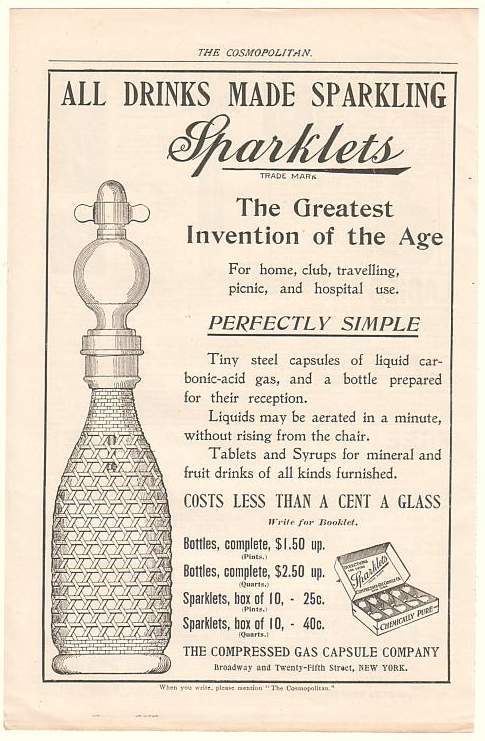
Sparklets Seltzer Syphon Bottles - Early History


My love affair with Sparklets Syphon (seltzer) bottles began in the early 1990s when I first laid eyes on one in a little antique shop located in an area of Orlando, boarding Winter Park, called Antique Alley. It was a chance meeting, the scenario went like this: instantaneous attraction, best price negotiation followed by cash out of pocket! I now possessed the inanimate object of my affection! I had never seen a seltzer bottle so classically art deco in design, or so I thought at the time. Instantaneous fascination begets curiosity!


Of course, my Sparklets Syphon purchase (pictured upper left) was before you could just Google a search term and have a wealth of instantaneous internet information, there was no AOL or eBay and I’d never heard the word syphon. The shopkeeper didn't know much about the bottle, other than it made seltzer water and had all of the original parts. My limited personal knowledge coupled with the fact that my parents were martini drinkers, led to the mistaken notion that the bottle was of an art deco design and period. To me seltzer was purchased in little bottles and made by Canada Dry, stocked in the bar along with other often ignored little cans of pineapple, tomato and orange juice (eww) for those who didn't drink theirs neat.

Over the years my Sparklets research has opened a portal through which I became a virtual time traveler and has taken me across the globe, back through history, and across cultural oceans. The first stop, The Industrial Revolution, the beginnings of modern day consumerism and the obsession with Global market domination! How intriguing that a seltzer syphon bottle could so quintessentially represent and be so steeped in our global commerce history! The first siphons’ were credited to the French; my focus will remain with the Sparklets Syphon bottles, originally from Great Brittan; wherein my fixation lies.

Sparklets bottles were first exhibited at the Paris International Exhibition in 1900, called the Exposition Universelle. One the earliest references I found was an advertisement for Sparklets in the British Journal by the Sanitary Institute at Birmingham, England dated November 1898; wherein the properties of aeration were discussed as it applied to the treatment of waste water. When reading the one of the experiments, the bottle used to conduct the experiment was described in a was that it could have been a syphon bottle modification. During that time period, with the influx of a burgeoning population to the city and as a result of the industrial revolution, living conditions were beyond deplorable for most.

In an effort to properly frame the beginnings of Sparklets Bottles, a bit of history is in order and is sadly overlooked in most discussions. Reviewing this pivotal time in the development of man, his environment and economics is key to appreciating just how imbedded this single product is in our present day consumerism. While we continue to romanticize our understanding of the era through movies like Becoming Jane Austin and Jane Eyre, according to The UK and Future Statistics dot gov dot uk, the "population in England had doubled from 16.8 million in 1851 to 30.5 million in 1901", housing and sanitary concerns were at critical mass. There were no sewage lines or uniform waste water disposal methods, housing shortages meant severe over crowding; the mortality rate in industrialized areas was almost twice that of agricultural based communities. Not since the plagues were poverty, slums, disease, waste removal and water quality so negatively impacting human survival. The use and mistreatment of uneducated women and children as a form of cheap labor also kept wages low and contributed to the vicious cycle of poverty.  These conditions were mirrored, to some degree or another, across the globe in rapidly industrializing urban areas.

Advancements in the scientific community paralleled and intersected with industry; without going into too much detail, it is important to note studies on carbonic acid and its ability to kill bacteria were being discussed in high regard. I should also note that many of the French seltzer bottles contained lead and resulted in metal poisoning of the consumer had come to light.


The temperance movement had and continued to strive to combat the effects of alcohol abuse within depressed populaces. Water quality, waste water and sewage disposal were ambitiously being addressed despite being impeded by ignorance and clinging to old ways. The death of Queen Victoria in 1901 brought the Victorian era to a close and began a new period, the Edwardian era, and improved conditions. In the upper classes fashions rapidly changed, sports and travel were on the rise. Climbing disposable incomes and increased mechanization meant new products, communication systems, and an expansion of the new phenomenon called advertising.


Among the oldest American advertising I could find which referenced Sparklets, in the book “Public Opinion”, a compilation of  the publication "Public Opinion", authored by William A. Blade, shows a Sparklets classified style advertisement in the May 30, 1901 issue; stating “Soda Water in Your Own Home At One Cent a Glass” with an introductory $3.00 offer, a “trifling expense” ($5.00 regular price) for the first 100,000 orders. At that price shipping was included “east of the Rockies”, “west of these” meant an additional 50 cent shipping charge.

The images contained within this blog are either mine, used with permission or under the fair use doctrine.